Hedgehog beer

It was with no small degree of trepidation that I poured my first glass of ‘Old Prickly’ – the Snuffly Hedge Grog from the Hobsons brewery of Cleobury Mortimer, Shropshire. Brewed to celebrate the 30th anniversary of the founding of the British Hedgehog Preservation Society, the ale was lighter in colour than I thought it would be. And there was a pleasing aroma as I took a deep breath.

I love a good beer, so why be worried?

Because I have been somewhere very similar before. Have a look at my piece on hedgehog whisky to see why … and you might understand why. In fact in the blog entry I was a little polite to the drink. On revisiting it I can attest it to be one of the foulest excrescences – rarely have I seen anyone finish even the the merest dampening of a glass without a grimace.

So what would the beer hold? On its arrival I was excited ….

Continue reading

Events

The Beauty in the Beast is now most definitely launched – but things keep happening to stop me getting back to work! I am about to head up to BBC Oxford to be a guest on the Jo Thoenes show … wonder if I will get away with any rude jokes this time?

Then, on Sunday, my first real outing with THE NEW TALK … I did a rehearsal at my launch event last Saturday which went really well and thanks to the creative and delicately framed feedback, I am happy to make some substantial changes. But Sunday, the 13th May, is the first festival, the Swindon Festival of Literature. I did a show on this day of the festival a few years ago – the Children and Families open day – and it was great fun. The venue, Lower Shaw Farm, is worth a visit, even without the presence of me and my stories of gentle eccentricities of my fellow wildlife lovers. Continue reading

Amazing opportunity

This is a bit of a local entry – in that it will be of most interest to people who are not too far away from Oxford … but will also be of interest to people passionate about hedgehogs.

Whenever I give talks I always say how much fun is to be had from getting really close to wild hedgehogs – how much of an insight into the animal can come from simply observing them in their natural habitat. And I also say, if you ever see a note from someone looking for volunteers to help them with some research – grab the opportunity in both hands and don’t let go ….  Continue reading

Badgers and Bats

Okay – an experiment. Or a warning!

Things are going to be changing around here in the next month or so, my new website is being built to arrive in time for the launch of my new book, The Beauty in the Beast (published by Simon and Schuster at the end of April). And part of this new website will be a little additional bit to go with the book – I recorded all of the interviews with my wonderful animal advocates, and am now in the process of editing them into short pieces … so not only will you be able to read about these amazing people, you will be able to hear them too. Continue reading

Lacto-free

First – thank you for the many people who took time to read through the last post and the many many comments. I was surprised at the depth of feeling and hope that I have not re-started any once forgotten problems.

Reading through what has been written, I think I have a better handle on my position. Or at least a way of expressing it:

  • No wild animals should ever be taken from the wild and kept as a pet.
  • I think that hedgehogs, of whatever species, belong in the wild.
  • Pet hedgehogs (African species, possibly hybrids, and possibly subject to 10 or 20 generations of captivity) are unable to be returned to the wild.
  • The welfare of any hedgehogs that are kept in captivity should be paramount.
  • Breeding hedgehogs for profit is likely to lead to a reduction of the quality of conditions in which hedgehogs are kept.
  • If you are going to look after a pet hedgehog then please use this position to help promote the really important issues surrounding the well-being of ‘real’ hedgehogs out in the wild.
  • ‘They are just so cute’ is NOT reason enough to keep an animal in captivity (these are not animated teddy-bears). Continue reading

A real hedgehog dilemma …

Author Daniel Allen invited me to a meeting with two pet hedgehog breeders in hope, I think, of a fight. He is writing a book about exotic pet keepers and their animals and has been on a peculiar tour of coatis, pythons, raccoons and ant-eaters in search of a bit of understanding as to what motivates the choice of these unlikely house-guests.

My position on pet hedgehogs is pretty well known. Having had a brilliantly eccentric time in Denver, Colorado at the Rocky Mountain Hedgehog Show, I was well aware of what the pet hedgehog world can generate. And I have written about the sporadic attempts by exotic pet breeders in the UK to kick-start a fad-pet craze. Continue reading

Blue Peter

I was visiting my mother this weekend and found myself browsing the bookshelf in the old playroom – and while much of the evidence of childish times has gone there was a block of books that stood out. Blue Peter Annuals from 1972 to 1980. My first book, their ninth, was a complete treat for me as a six year old. I thought the world of John Noakes and Shep.
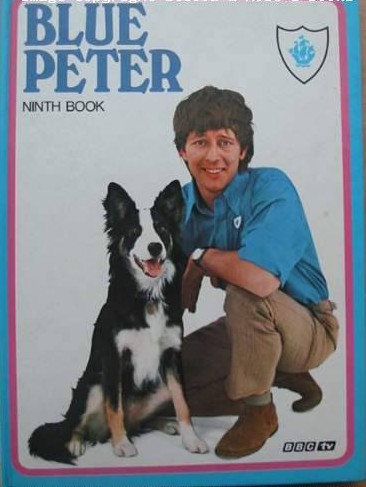
Flicking through these Annuals I found I recognised so much – though why they insisted on putting Valerie Singleton in such odd period costumes escapes me. Blue Peter was a very important part of my childhood.

So, can you imagine the tremor of excitement when the wonderful folk at Firebird PR (who do so much to help the People’s Trust for Endangered Species) told me that Blue Peter might be interested in doing a hedgehog feature and that I might be involved?

I add the ‘mights’ as I am well aware of the slippery nature of Auntie Beeb – not everything that is promised comes to light … but the mights grew stronger and stronger. I secured some stunt hedgehogs from Hedgehog Bottom Rescue, near Reading (thanks Gill); Firebird found some willing school children and I ironed my shirt (this was getting serious).

To prime myself I watched an episode on i-player – oh my … how young …

But unfortunately the children have aged – the show is now aimed at 10 yrs + … so my wonderful duo of Mati and Pip  were too young to be part of the show.

And then last Friday it really happened. The Blue Peter team were great – the weather was toe-teasingly cold, I was very glad I pilfered my wife’s down jacket – and the presenter, Naomi Wilkinson – showed how that sort of work should be done. The interview segment was focussed on Hedgehog Street – how to make gardens hedgehog friendly and interconnected.
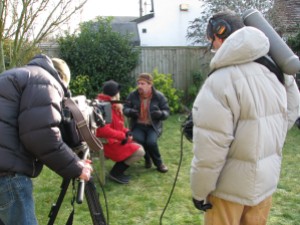
Then a wonderful thatcher called Kit stepped in to help Milly and Joe make a hedgehog house. Which then lead up to the finale – where we placed the hedgehog house under a big bush and I introduced Gill’s ‘stunt ‘hogs’ to the show.
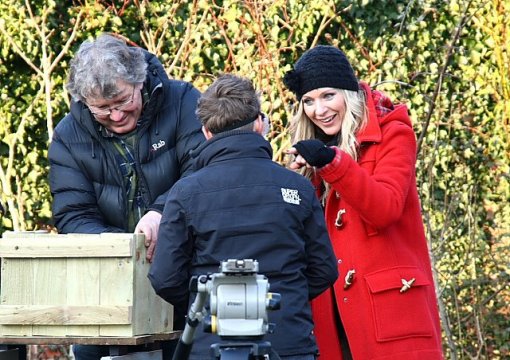
photo from Hedgehog Bottom Rescue

These two hedgehogs had been in her care for a while and will be released when the weather is a little milder. We made the point that these were ‘stunt’ hogs and that hedgehogs should not be out in the day … people always complain, but I really think it is important that we seduce people with images of hedgehogs, and then, when they are drawn in, we can educate them.

As I placed the hedgehogs in front of the newly made hedgehog house I declared that, obviously, they would not go into it right away. At that, Rogan, one of the hedgehogs, took a look at me and decided to prove me wrong, by making a bee-line for the entrance tunnel and disappearing.
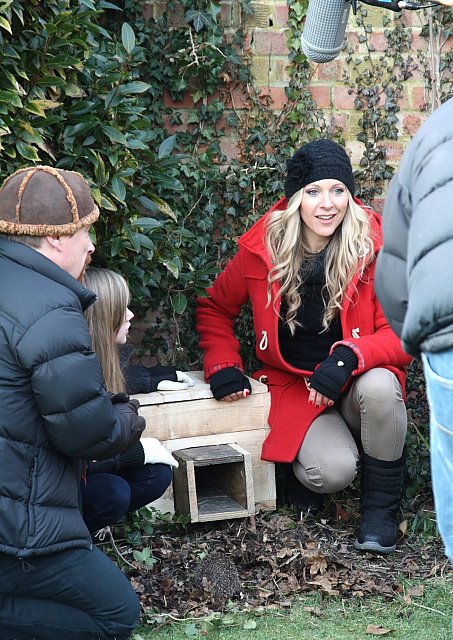
photo from Hedgehog Bottom Rescue

This resulted in general amazement – I was thrilled! And then, a little later, we took the back of the box and propped a night-vision camera in the opening, allowing them to film Rogan entering the hedgehog house from a different angle. What a very excellent stunt ‘hog.

I am so excited about this – the short film will be broadcast on Thursday 9th February at 1745 on CBBC, and repeated on Friday 10th February on BBC1 at 1630. I am excited because I will be on Blue Peter, obviously, but I am mainly excited because this has been a great opportunity to talk to a different audience about the importance of making your garden not just hedgehog friendly, but wildlife friendly. What is good for hedgehogs is good for so much else. And our project – run in conjunction with the PTES and the British Hedgehog Preservation SocietyHedgehog Street – is such a great way to get people and their communities involved.

It is possible, however, that the main thrill has come from this …
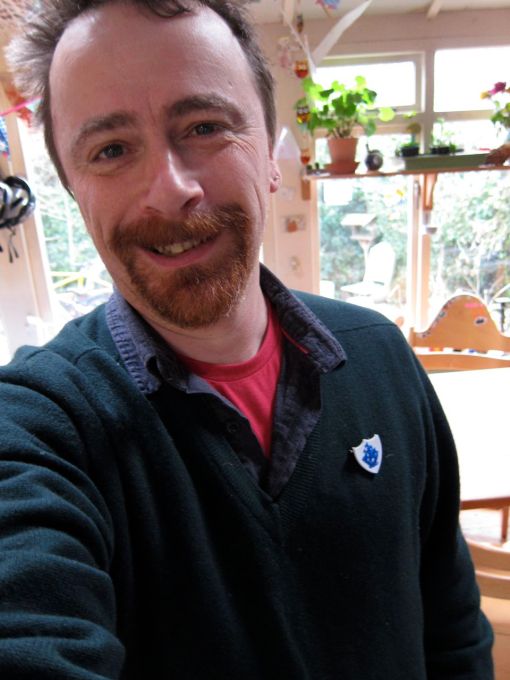
I now have a Blue Peter badge … something that the six-year old me, looking at the wonderful John Noakes doing derring-do, dreamt of earning.


Why I love the interconnectedness of all things!

I put up the last post in a hope to track down the Turkish artist Elvan Alpay. I was not sure if it would work, the Kevin Bacon game is fun – degrees of separation – but can it have a practical application?

Within 24 hours I was in email contact with Elvan’s representative and within 48 hours I had secured an interview and permission to use her pictures in my (soon to be finished) book for Reaktion.

It turns out that my brother-in-law, Sean, knows someone who knows someone who knows someone who is in the art world in Turkey … not quite sure the real number of degrees of separation there were, but I am REALLY impressed. As I am by Sean’s company’s work … Smoke and Mirrors. I suggest a brief break from work and a rummage through the reels highlighting some of the amazing special effects he manages to create (biggest claim to fame, for me – he did the invisibility cloak in the first Harry Potter … I asked him if he still had it, but since putting it down has not been able to find it!)

Elvan Alpay

Having a google alert set to hedgehog keeps it busy … I just need to learn how to wean out the ‘sonic’. But today there was something different. A Turkish artist, Elvan Alpay, has an exhibition launching in Istanbul – at Galeri Nev. And it features a remarkable image – which I have copied from the gallery website only in the interests of promoting her work, not stealing it …

The piece about her is here. She sounds fascinating – and this is the motive behind this blog … is there anyone out there who has a contact for Elvan Alpay? I have written to the gallery and spend an age googling … but no direct way to get in touch. I would be very interested in getting permission for using this image in the new book I am writing for Reakion. If you know of a way of getting in touch with her, please let me know. With many thanks.

Hibernation Survey

What moves from the south of England to the north of Scotland at walking pace, and goes slower up hill? (answer at the end of this blog)

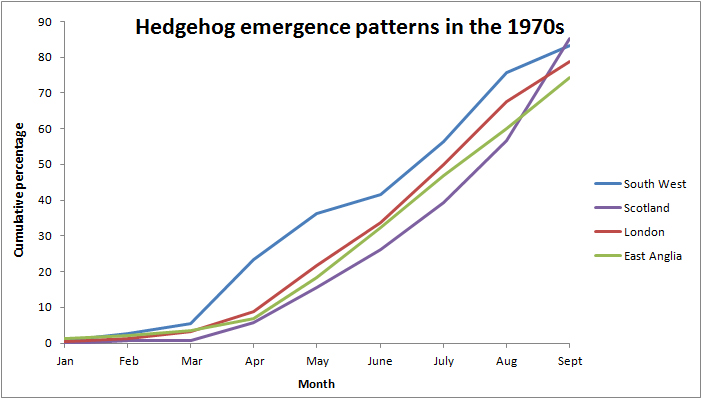
Forty years ago my mentor, Pat Morris, did a fascinating survey looking at the different times hedgehogs emerged from hibernation across the country. He showed what one would expect, that hedgehogs emerge from hibernation earlier in the warmer south west of England and later in the north of Scotland.

As you can see from this graph of his work, the evidence is clear. And like the good scientist he is, he has kept this idea bubbling away … because often scientists will find that data collected for one purpose can later be used to investigate another.

His survey measured the geographical impact on hibernation. But it allows us now to look at the temporal impact too – how emergence from hibernation has changed over time.

Why should we be interested in this?

Because the biggest environmental story of the moment could be revealed in the data – the impact that a warming climate has had on us so far might be hardly noticeable, we are so insulated from the outside world that we hardly notice the passing of the seasons! But for wildlife out in the wilds – well subtle changes in climate can manifest subtle changes in behaviour. And one measure is WHEN the hedgehogs emerge from hibernation – which we can measure most effectively not with specialists in lab coats or satellites – but with YOU – citizen science.

The survey is simple – all you need to know is HERE on the Hedgehog Street website. You can take part in a study of phenology! (phenology is the study of periodic plant and animal life cycle events and how these are influenced by seasonal and interannual variations in climate (taken from Wikipedia … which is down today in protest at web restricting legislation))

This is not the first use of citizen science to study the changes in the seasons, for example the Woodland Trust and the Centre for Ecology and Hydrology also run Nature’s Calendar – but the hedgehog hibernation survey is going to be a wonderful addition to our knowledge of the changes afoot.

And why should we worry?

Well, before we can worry we really need to see what is happening … so PLEASE do the survey. However, there are concerns about how changes in the climate might affect the lot of the hedgehog. More extreme weather events, for example, could be bad. Warmer winters might NOT benefit hedgehogs either. Being disturbed by unexpected mildness during the winter can deplete important fat reserves within the hedgehog, reducing its chances of survival when it re-enters hibernation.

There is a chance that if there are shorter, milder winters, hedgehogs might also benefit from being able to feed longer before entering hibernation – putting on more weight and increasing their chances of survival. This would be particularly valuable for late born young (possibly second litters).

And if climate changes are so severe that in the end hedgehogs give up hibernation, should we worry?

Perhaps surprisingly, no. Hedgehogs do not NEED to hibernate – and when our European hedgehogs were exported to New Zealand in 1855 (a long story – read my book for more details!) the ones that made their home in the warmer north island hardly hibernate at all.

But to repeat – for now what we need is data – data which we can use to compare now with Pat’s first study 40 years ago. It will be fascinating to see what changes there have been – so please join up and fill in the survey.

And the answer to the question at the top? … Spring!