Craven image

For those of a certain age, there is one man who was there as our conduit to adult news – John Craven and his Newsround introduced me to war (Vietnam) in the early 1970s. And now? He presents Countryfile on BBC1 – Sunday at 1720. And on the 11th April – he has managed to secure one of the journalistic scoops of his career – better than John Simpson bringing the realities of napalmed villages to school children, perhaps – me and a hedgehog!

In what might be a record for time travelled to actual interview – it took me 9 hours to get to and from the Wildwood Trust near Herne Bay, Kent. And the interview, just the one take (of course) took 2 minutes! But we did get to have lunch together, after I had made him pose for this image:

That was a fantastic hedgehog to be interviewed with – he was calm and just inquisitive enough to make it interesting.

The paperback is due out on Thursday … but I am still wallowing in the glow of being referred to as endearingly batty in the national press!

Endearing Battiness

I have just had  call from my agent, Patrick Walsh, who had picked up a copy of the Guardian on his way back from the airport (he has just spent two weeks cuddling baby elephants with Daphne Sheldrick in Kenya) … and he was so excited. It is the possibly the best review my book has ever received … even if it does describe me as having an ‘endearing battiness’.

He picks up on the fact that this could be first and only book ever published to be endorsed by both Ann Widdecombe and Jeanette Winterson … oh, just read it and imagine how warm my cockles are feeling!

You can read it online at:

http://www.guardian.co.uk/books/2010/mar/27/prickly-affair-charm-hedgehog-warwick

Or, because I care for the state of your fingers, here:

Oh, come on, I thought. A whole book about hedgehogs? All right then, bring it on. After all, it is one of the purposes of this column to introduce not only you, but its author, to unfamiliar or unlikely subjects. And, speaking personally, I have very little opinion about hedgehogs, except for the usual idées reçues about how Gypsies are said to bake them in clay, how on earth they mate (very carefully, ho ho), and don’t they all have fleas?

Well, after reading this book, not only am I significantly better informed about the little spiny creatures, I feel considerably better disposed towards them. I am now hedgehog-conscious.

I am also much more aware of certain pockets of life in this country. One of the charms of this book is the endearing battiness of its author – but in contrast to the benign loopiness of some of the people he interviews, he is a calm and sober commentator.

You wouldn’t think so at first, though. The picture we initially get of Hugh Warwick is that of a wet, smelly and somewhat obsessive naturalist up at all hours of the night, wringing the rain out of his beard and chasing carefully after hedgehogs with tracking devices on their backs. These are luminous, so that a courting pair appear as “an amazing dance of two sprites, one circling the other, with periodic leaps and sneezes like waltzing glow-worms with hay-fever”. (Although female hedgehogs spend a lot of time fending off the attentions of ardent males – I make no comment – there is still quite a bit of noisy hedgehog sex in here, including an anecdote from Bremen, where police officers called to investigate some strange noises found “two hedgehogs described unusually eloquently by the police spokesman as being ‘loudly engaged in ensuring the continuity of their species’.”)

Hedgehogs are eccentric themselves, so it should come as no surprise that they attract the devotion of the oddball. There will be few other books, if any, which are endorsed, as this one is, by both Ann Widdecombe and Jeanette Winterson. (Which is not to say that either of them is odd, but . . . well, you know what I mean.) In fact, you could fill up the New Statesman’s “This England” column for a year with material from this book. Meet Barbara Roberts, chatelaine of Withington Hedgehog Care, who tries out all the drugs she uses on her charges herself first (“Well, Metacam tastes really quite nice, but they hate one of the antibiotics and I can see why”); or Elaine Drewrey, mother of the lead singer of the band Swing Out Sister, who has the messiest house Warwick has ever seen. “Anyway, no hedgehog has ever complained about the state of the house and that is what matters to me.”

Americans, of course, have to do things bigger than everyone else, so when Warwick goes to the International Hedgehog Olympic Games, prepare yourself for a parade of lunacy beyond the imagination of any satirist. Never mind Zug Standing Bear, who, after an eye-opening time examining American atrocities in Vietnam, used to be one of Gerald Ford’s bodyguards and now has a champion hog called Buttercup – he’s a regular guy. Check out Dawn Wrobel, who communicates telepathically with her hedgehogs and asserts that the creatures call themselves “star children”. (As Warwick says helplessly at this point: “I would hate it if people thought I was not an open-minded sort, I really like to think I am, but . . .”) And just wait till you get to the business about the Rainbow Bridge. Credulity, even with the intermediary of sceptical paraphrase, can only be stretched so far.

So what is not to love about this book? It is funny, generous, kind, learned (a lot of ancient hedgehog lore), thoughtful, ecologically minded and – this is quite important, actually – unsentimental. (The way badgers eat hedgehogs is somewhat unsettling, but then that’s the natural world for you.) I would never have imagined that a book on this subject would have me reading lots of bits of it out to anyone who would listen. But that’s what happened here. It achieves its purpose: and in its charm lies its success.

A Prickly Affair: The Charm of the Hedgehog by Hugh Warwick 304pp, Penguin, £9.99

Hedgehog Beijing

When I met Atom, the petite drummer from the Beijing punk band Hedgehog, I was immediately impressed by the sheer power in her four foot something frame. She might have appeared doll-like at first glance but as soon as you saw the determination in her eyes you realised she was someone with whom you should not trifle.

As we ate gorgeous food in a Beijing restaurant, Atom said something that caused everyone else to burst into fits of laughter. I prodded Poppy, my superb guide and interpreter, and asked what was going on. I should point out that just before the laughter I was feeling rather pleased with myself. I had managed to reach across the table and pick up a spicy green bean with my chopsticks. And the reason for the laughter? Atom had just said, “he uses his chopsticks just like a baby!”

The photograph appeared beside an interview with Matthew Niederhauser on CNNGO website.

Have a listen to the noisy bunch … click here.

My time in China – spent looking for the wonderfully named Hugh’s Hedgehog (there is chapter of my book dedicated to this, so don’t think you are going to get too much of the story here!) – smashed many of my prejudices I had about the country. I thought I would struggle, yet I loved it. The vegetarian food was some of the best food I have ever eaten, and there was one night in a Yunnan style restaurant that I had a series of dishes that left me tingling from spice and pleasure. I might add the list later – it was wonderful.

And another prejudice that was broken – not all animals are treated as snacks – and hedgehogs are, at least around Beijing, one of a small few sacred animals. They are revered. How about that – at two of the extremes of their range – UK and China – the hedgehog is a much more significant animal than we at first think. Is hedgehog-love a universal thing?

pip pip

The ultimate book group?

I got an invitation from Simon Scarrow, author of historical fiction bestsellers featuring Roman legionaries or Wellington (who would have thought that he was such an expert violinist?). I first met Simon when we were asked to talk to a gathering of booksellers – and we suffered some of the very worst food ever made, ever. Everyone on my table left at least half of the food – the roasted potatoes were so hard that they could have been effectively used by Wellington to disable the French.

That event was the first time I had been in the position of ‘after-dinner speaker’ – and I made a mistake of remaining absolutely sober for hours (it takes time to make the potatoes that inedible) and I also made a mistake (unavoidable) of talking non-stop for four hours about hedgehogs, before having to do my bit about hedgehogs … I felt I had said everything a hundred times already.

To make me feel worse about it all, the final ‘act’ was Rick Wakeman. Former prog-rock keyboard extravegantist, he has remodelled himself as a very ‘grump old man’ – and has a great line in anecdotes from his life on the road of excees, so there was plenty of bawdiness do with drugs and booze and toilets. He got the big laughs and I left feeling rather deflated (and hungry).

But my feeble performance made an impact and the event generated interest and sales (just in case you have not read it yet, here is another large link to Amazon). And it also generated an email from Simon Scarrow – asking me to come and talk to his book group just outside Norwich. So the meal definitely bore fruit.

The last book group I talked to was the one my wife is part of – and the biggest problem I had was finding that only a couple of people had actually bought my book – and then shared it around … this was them missing the point BIG TIME! Book groups tend to be small and un-resourced, but then I was not aware of quite the standing Simon Scarrow has – it took him pointing out that he was pipped to the number one slot by Katie Price’s ghost written novel to make me realise that he is in a very different league of sales to me and my hedgehogs.

Going all the way to Norwich, I felt I might as well make the most of my time, so asked if there were any schools nearby I could do a talk in – and ended up having a wonderful hour with the year six class of The Stoke Holy Cross Primary School. I was amazed that quite a few of the children came for a second sitting as they accompanied their parents to the evening event.

The guests had been asked to bring along hedgehog-related food (fortunately hedgehogs are still hibernating or someone might have brought me a dish of hedgehog spaghetti carbonara (recipe in the book)) – and I managed to grab some photos before the feasting demolished most of them.

The talk was great fun – and discovering that there was a senior scientist from the British Trust for Ornithology present certainly helped keep me on my toes – as did the approach from the genial former-member of Special Branch (now trainer) who was very interested in some of my interesting friends!

So, that rates as the most impressive book group to date. Anyone else want to invite me along?

There is a chance to catch up with me giving talks in Oxford on Thursday 8th April and in Exeter on 20th April (I will post the venue when I know).

pip pip

Paperback writer

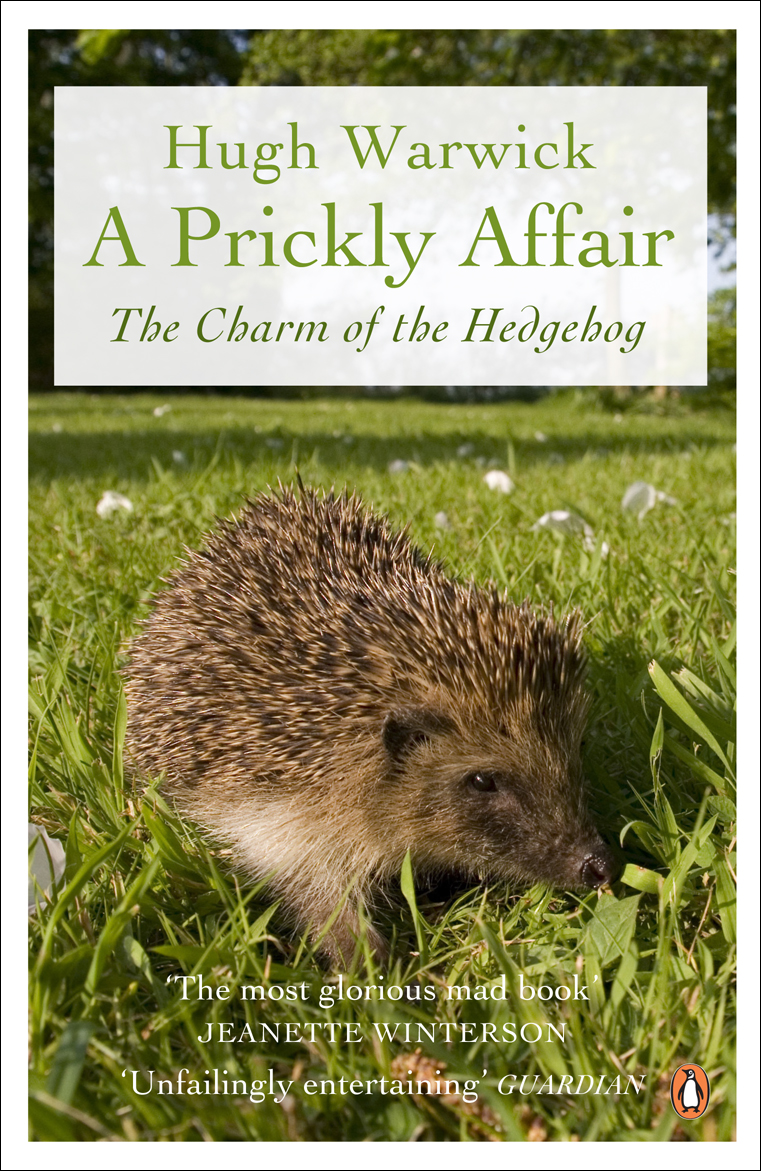
I have a little thrill of excitement as I realise that it is only five weeks until the launch of the paperback of A Prickly Affair …  a Penguin paperback no less …. and I thought that it might be nice to let you have a preview of the cover:

You can get it from Amazon if you want, better still, ask your local bookshop to stock it  … or just book me to give a talk and I will bring as many as I can carry!

Oh – and if I did not already love Jeanette Winterson … wow!

How much is a hedgehog worth?

The massive difference in people’s attitudes to wildlife is starkly revealed today. On the one had the Scotsman has reported on the costs of the hedgehog-eradication programme in the Uists – so far £1.2 million has been spent, and they are planning on spending a further £1 million. This is all with the aim of improving the breeding success of ground-nesting birds – a few hedgehogs were introduced in 1974 to control slugs and snails in a garden, but have since been enjoying the freedom of the islands (freedom from badgers and heavy traffic) – unfortunately they have also been enjoying the freedom of the massive egg-breakfast laid for them by the internationally important populations of wading birds, like dunlin and ringed plover.

When the eradication started, in 2003, there was a furore as Scottish Natural Heritage were killing the hedgehogs, and many of us ended up helping to rescue them. Eventually we managed to persuade them that killing was unnecessary (for a more detailed analysis – here is a paper that summarises the research I did) and since 2006 SNH have been handing the animals over to the one-time rescuers to relocate on the mainland.

And how much is that per hedgehog? Over £800 to remove each and every hedgehog. And that is not the half of it – up until this year, the work has, in effect, been subsidised by animal welfare charities – who have used their voluntary labour to re-home the animals after their deportation from the Outer Hebrides. All of the hedgehogs come to the indescribably wonderful Hessilhead Wildlife Rescue hospital.

The other measure of our attitudes to hedgehogs and wildlife in general is a story that features another wildlife rescue hospital.  The Guardian is running a piece today, including video, from Vale Wildlife Rescue in Gloucestershire, which is making the rather important point that hungry wildlife needs to be fed and the food costs money. It is not just Vale – and I am sure they would be the first to make this clear – but wildlife rescue centres all over the country and feeling the pinch and need a little help. Not just money – find out what they actually need – is it old newspapers, tins of dog food – and see what you can do. If only all the wildlife rescuers got £800 for each hedgehog!!

And back up in the Uists, has all this money been well spent? Well, when the British Trust for Ornithology did a survey, to investigate the impact the removal of hedgehogs was having on the breeding success of ground nesting birds, they uncovered something rather startling: in some areas where hedgehogs had been removed, the birds were doing LESS well than where the hedgehogs were left alone and declines in dunlin were happening at the same rate in areas with hedgehogs and on islands without.

SNH have now acknowledge this and said that there is no “statistically robust evidence” that all their work “has as yet resulted in a positive response in wader populations”. They continue to suggest that there may be “other variables” having an impact on the bird populations … well, I hate to say ‘I told you so’ … but ‘I TOLD YOU SO’ … I did a study into a very similar story, up on North Ronaldsay, the most northerly of the Orkney archipelago, way back in 1986, and found that while hedgehogs did take some eggs, they were not the main cause of the problem. All too often, wildlife managers leap to a ‘Daily Mail-esque’ conclusion – blame it on the illegal immigrant and get rid of them by what ever means necessary. Well, sometimes it is not the different-looking newcomer who is at fault … so rather than spending another million pounds shifting hedgehogs, perhaps now is time to look at the problem afresh.

CSI Hedgehog

I have just met a team straight out of the Crime Scenes Investigator series that is begging to be made – CSI Hedgehog.

How did that hedgehog die?

For most of us, the only sight we get of a dead hedgehog is flat on the road. The staple of many jokes …

Why did the hedgehog cross the road? To see its flat mate.

Why did the hedgehog cross the road? To show he had guts.

Why did the hedgehog cross the road, jump up and down in a muddy puddle and return to the same side? Because it was a dirty double crossing hedgehog.

Already we have been learning so much thanks to these sacrifices to our need for speed – it is one of the most reliable techniques for assessing presence and absence of hedgehogs in an area. And when repeated, year after year, as it is with the Mammals on Roads project run by the People’s Trust for Endangered Species, it can give us an idea of how populations of hedgehogs are fluctuating. It does not tell us how many there are, but it does tell us if they are increasing or decreasing, as there has yet to be any evidence of hedgehogs learning to avoid cars.

But now there is another way in which unfortunate corpses can assist our understanding of the wonderful world of the hedgehog.

The team of Crime Scenes Investigators will be on hand to undertake meticulous studies of the insides of hedgehogs that have been found dead in people’s gardens. These animals will be a ‘silent witness’ to the environment in which they lived. The experts, Katie Conville, Becki Lawson along with team leader Andrew Cunningham, from the Zoological Society of London, will try and work out not just what killed the animal, but also what sub-lethal effects were at play.

Parasitology, virology and bacteriology will all help to uncover the infectious diseases that have left the hedgehogs ill at ease. And they will also, when there is evidence to warrant, investigate what manmade chemicals might be lurking, undermining the health of our slug-munching friends.

This is not just about the fate of individual hedgehogs – there is also the potential to uncover what has been causing the decline in hedgehog numbers around the UK. This sort of work has already uncovered the cause of the mass mortality of greenfinches, as well as uncover the truth behind frog deaths and cetacean strandings.

But, as ever, there is an issue of money – so if anyone is reading this and feels particularly flush, drop a line to the British Hedgehog Preservation Society (or remember them in your will) – and maybe we can have our very own CSI hedgehog!!